
Keyword Cannibalization on a Small Blog: Fix It or Ignore It?
Two of your pages showing for one query is not automatically a problem. Here is how a small blog decides between fixing it and leaving it.Key takeawaysTwo...
19 October 2026 · 5 min read

Two of your pages showing for one query is not automatically a problem. Here is how a small blog decides between fixing it and leaving it.
Key takeaways
- Two pages from one site appearing for the same query is not automatically a problem, according to Google's John Mueller.
- The real problems are near-duplicate pages, thin pages, unfocused pages and weak internal linking.
- Decide per query: merge, differentiate, or link and leave.
- Use Search Console to see which pages actually get impressions for the query, rather than guessing.

What is keyword cannibalization?
The usual definition: two or more of your pages compete for the same search query, so neither ranks as well as one strong page would. It is a popular SEO diagnosis, and it is contested.
What does Google actually say?
In September 2025, Search Engine Journal reported Mueller's response to a question about it. His point: it is not really "cannibalization" if it's theoretical. Search Console only shows impressions for pages that were actually displayed. Several pages from one site appearing for the same query is not inherently a problem, and pages are not duplicates just because they appear in the same results. He suggested effort is often better spent improving one strong page and removing unnecessary duplication.
The same article notes that the situations worth fixing are different ones: pages too long and unfocused, off-topic passages, weak internal linking, thin content, and near-duplicates.
How do I tell a real problem from a harmless overlap?
Open Search Console, filter Performance by the query, and view Pages. Then ask:
| What you see | Likely meaning | Action |
|---|---|---|
| Two pages, both with healthy impressions and clicks, different intents | Harmless overlap | Link them to each other, leave both |
| Two pages, same intent, one clearly weaker | Duplication | Merge into the stronger, redirect the weaker |
| The ranking page swaps back and forth with a similar one | Unclear signal | Pick a primary, link to it from the other with clear anchor text |
| A thin post and a long guide on the same topic | Thin content | Fold the thin one into the guide |
Remember how position is calculated: Search Console reports the highest position your site held for a query, averaged across queries. A page that "wobbles" may just be one of several shown.
A step-by-step diagnosis
- List the query and both URLs.
- Compare intent. Would one reader want both pages, or only one?
- Compare performance. Clicks, impressions, CTR and position for each over 3 months.
- Compare quality. Which page is more complete, more current, better linked?
- Choose an action from the table above.
- Write it down with the date so you can check later.
A worked example (illustrative)
Suppose a travel blog has "Hesaraghatta Lake day trip" and "Things to do near Hesaraghatta Lake" and both appear for "hesaraghatta lake". If the first is a route-and-timing guide and the second is a list of nearby stops, they serve different intents: link them to each other and leave both. If both are 500-word posts that repeat the same route and timings, merge the weaker into the stronger. The posts here are a hypothetical illustration, not a statement about Wandering Bong's actual archive.
How do I merge two posts safely?
- Pick the stronger URL as the keeper.
- Move useful sections from the other into it.
- Redirect the old URL to the keeper (301).
- Update internal links to point at the keeper.
- Re-check Search Console after a few weeks.
| Step | Common slip |
|---|---|
| Choose the keeper | Picking the newer rather than the stronger |
| Merge content | Copying everything instead of what's unique |
| Redirect | Forgetting the old URL's backlinks |
| Update links | Leaving old internal links in place |
How does Roami help?
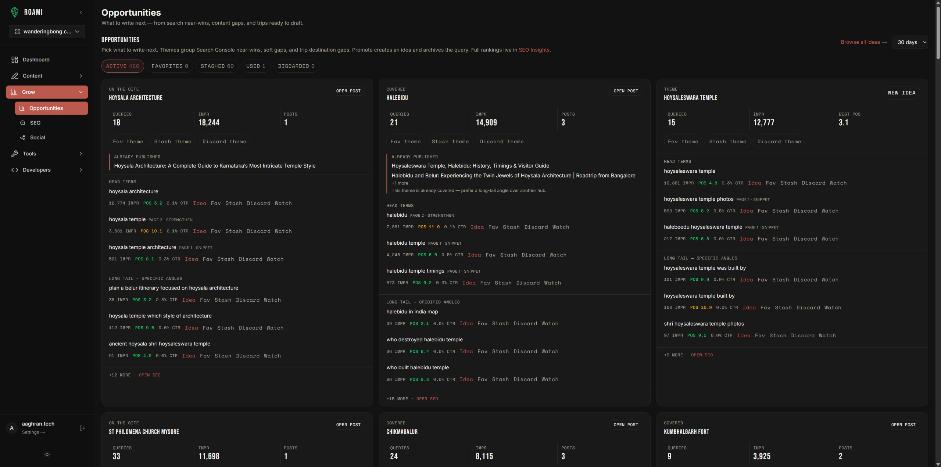
Ask your agent to find similar content (find_similar_content), pull query data (get_search_console_performance), and list candidates. It can draft the merged text as a new draft. You decide, and you publish.
Example prompt: "Find posts in my Wandering Bong project that overlap on 'hesaraghatta lake', show their Search Console performance, and draft a merge plan. Don't change anything yet."
Frequently asked questions
Is there a Google penalty for it? Not in the sources used here. The sources frame it as a quality and focus problem, not a penalty.
Should I use canonicals? For true duplicates, a redirect or canonical may fit. For different intents, link instead.
How many posts per topic is too many? There is no number. Each should have a distinct purpose.
Try it
Try Roami and run the overlap prompt above. Related: Orphan Pages and Internal Links, Blog SEO Audit Checklist.
Sources (checked 18 Oct 2026)
Next step: connect an agent, or audit your archive first.
Drafted with an agent in Roami, edited and published by Aaghran. This blog runs on Roami.